

Like many other people I know, while there is a drive to be creative, there is a strong undercurrent of anticipation of actually putting it out there to be judged by the whole word. Luckily this book by Austin Kleon has given me a number of tools to employ to overcome this nervousness.
The fist chapter is called “You don’t have to be a genius” and I’m sure I heard a collective sigh of relief as I read these words. Or maybe it was just me?! This starts by highlighting that the ‘lone genius’ is a myth. If you look at many instances of leaders in a particular area, they are likely part of a strong community of leaders.
If this works for the worlds best in their field, surely it make sense that we act in a similar way? Rather than just watching from the sidelines, why don’t you engage with those you look up to. This is without doubt one of the best parts of social media. In what other realm can we directly converse with the people we most respect? We don’t have to be geniuses to take part in these discussions or forums, but it is essential that we contribute.
While professionals may have the titles and adoration, amateurs don’t necessarily have any less love or understanding of the topic. So use this to your benefit, continue your progress in an open way so people can follow your journey and learn along the way. Your raw enthuisam is contagious and will attract others to follow you.
The final key part of this chapter is that if your work is not online in some way or another, it may as well not as exist as you’re restricting your potential fanbase so drastically. So share, share, share!
Moving on, the book asks what work is and how people will engage with it? Work is a noun and a verb. If you’re an artist, then people will come to look at your finished work (the noun), but they are also going to be interested in the process of the work (the verb), so why not show both?
This is why I love articles. Not only does it help shape my understanding and knowledge of a particular topic, but I like to think (yeah, right!) that someone may look at the processes I go through and find that just as interesting or helpful.
So let’s not just focus on the noun, but also the verb. We can document our processes and systems in such a way that this will also become an art form itself. So rather than just painting one painting a month, we’re showing our work everyday in the creativity process.
Following this, is the concept of the consistency of sharing our work. Put something small out each day. The book points out that while 90% of our work may be rubbish, we don’t know which part is rubbish. And that decision isn’t ours (as in the creator) to make. So put your work out there, and let the online community decide which 10% of your work is gold! That small article that you’re not sure of may just be that one article that goes viral, or has a profound impact on someone. Realistically, it’s a numbers game, so again like earlier, share, share, share!
That said, there is no point in sharing for the sake of it. Our work needs to be either entertaining or helpful, the sweet spot is hitting both. So ask yourself, would I read/watch/listen to this if someone else created it??
In the next chapter, this books looks at our influence and how these can help to guide our work. For instance, all writers read books, they inspire and then reinforce the writing. They’re not exclusive, but more like different ends of the same spectrum.
I find this really interesting, and helps me understand why I love consuming online content so much. People like MKBHD, Ali Abdaal and Thomas Frank all shape my interpretation of YouTube videos, and how I end up making my own, whether that is topic, content or style.
When you find work that you love, champion it. Shout it from the rooftops. Good work deserves to be consumed, so do your bit in making it happen. But, make sure that it gets the credit it deserves by referencing where it came from. You know it’s the right thing to do….
One thing that I found really interesting is that no matter what work we are creating, you need to do your best to tell it’s story. For instance, we have the below painting hanging in our lounge.
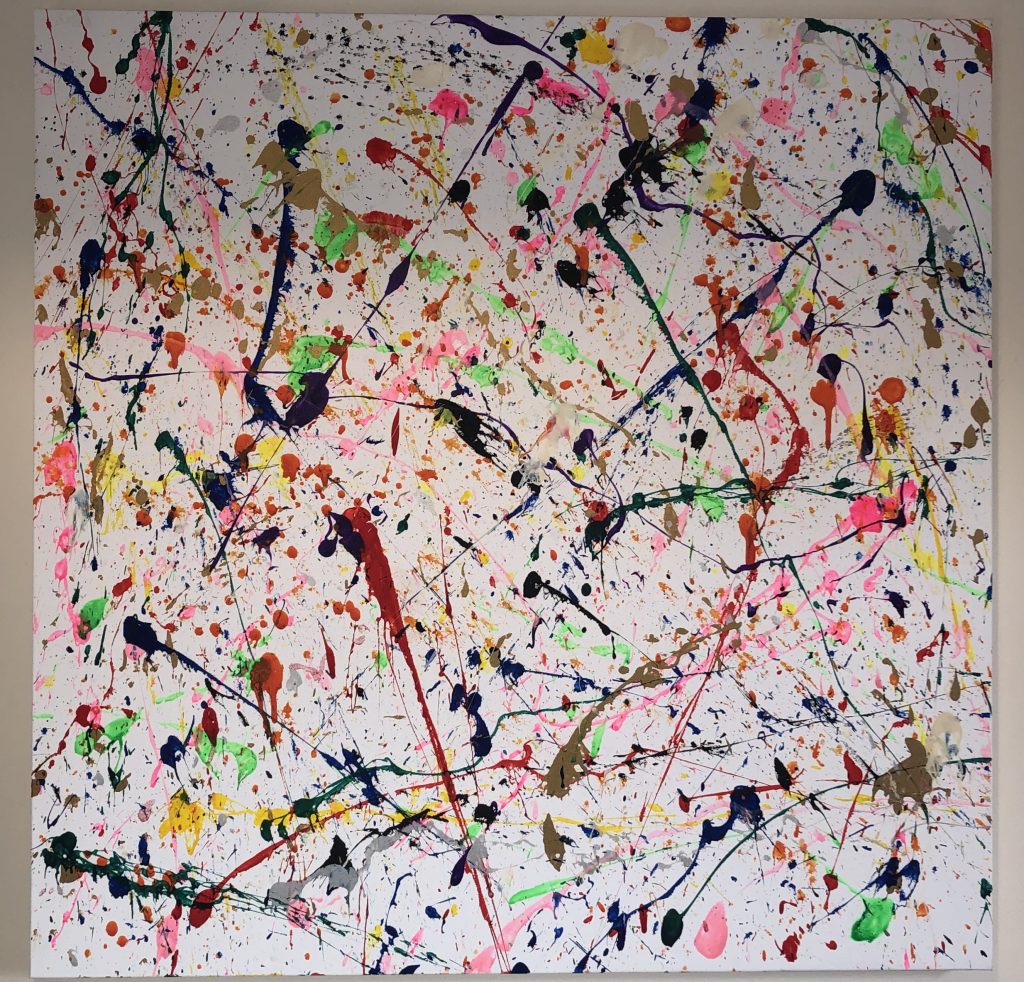
Thankfully (and obviously), we’re not artists, but this painting is hanging because fo the story rather than the finished article. This painting was created by me, my wife and our son who was 7yo at the time, and it was done as an ‘art lesson’ during Lockdown in May 2020. The story is interesting, and personal but also reminds us of one of the most bizarre times of our lives. But importantly, one we get through, so this painting always makes me smile 🙂
So, whatever it is you’re creating, tell a story as it will help you to create a bond between the consumer and your work. Just remember to keep your story honest (in good and bad times) and keep it simple. People like structure, and your story can help to provide that.
A part of your story can be to teach. If you’re passionate about what you’re doing, you’ll want yo share your love. This is definitely how I feel about my 3Es, and that is why I talk about them so much. Make your work informative or educational and it will create a far greater interest in your work.
I love the phrase in the next chapter; “don’t become human spam.” While we all by now (hopefully) understand that we need to consume to create, we also need to ensure that the work we are creating has some form of meaning. That meaning could be entertainment which is cool, but whatever it is you need to ensure it has a purpose.
For me, I think it is really important to create good content. We can all waffle on, but actually is that going to get us anywhere? It’s a bit like the difference between being busy and productive. Is your output actually useful/meaningful??
Unfortunately, one of the downsides to sharing your work is that you do leave yourself open to criticism. Luckily for me, none of my close friends, my parents or my wife don’t criticise me too much to my face, as I’m sure they’re the only people that are still reading this….
But the better we all get at this creating malarky, the more likely it is that someone will criticise our work. But we need to roll with the punches and take the feedback, but not necessarily to heart. It isn’t personal to your consumers, so try not to take it personally.
Now when it comes to trolls or keyboard warriors, we just need to ignore them, or block them. They’re just disagreeing with you for the sake of it, and it has not meaningful impact on you. I know, easier said than done right?!
Hopefully in time, there will come a stage where you can monetise your work, and there is nothing dirty or wrong about this. We all have bills to pay, and if you can make your income from creating content then it is extremely likely that you can dedicate more time to creating, which will in turn only improve your work.
Think of other ways that can increase knowledge of and interest in your work. Just keep drip feeding it out so it is always in peoples mind, without being human spam. Difficult, but you will find a balance.
The book finishes with a key message for me. We need to stick around. Don’t give up, and keep moving forwards. A bit like James Clear’s concept on habits and improvements, 1% each day compounds to make a huge difference over the course of a year.
There may be times that you put out rubbish content (in your eyes, anyway) or you may even have to reinvent or redirect, but whatever happens don’t stop moving.
Looking back to my early days, I thought that my procrastination was because I wanted everything to be perfect. But with the benefit of hindsight and some self truths, it’s because i was petrified. What would my family, my friends think?
But do you know what, I now have a bit of confidence about what I’m doing, but more importantly I enjoy it. At the moment, I’m not doing this for anyone else, but my benefit. I’m just showing my work in case people happen to find it entertaining or helpful. Great if they do, no dramas if not…
So, ask yourself. What’s the point in creating if you’re not going to show your work. Think about how you can get it out there, and what impact it is going to have on people. But if you need a bit more a nudge in the right direction, I would definitely recommend giving this book a read.
Show Your Work!: 10 Things Nobody Told You About Getting Discovered: 10 Ways to Share Your Creativity and Get DiscoveredThe above is an affiliate link that I may get a kickback from if you do purchase, but it won’t cost you any more! Thanks


Pingback: Document your creativity - DD10 - Mark Rance
Pingback: My 3Es - Mark Rance
Pingback: What’s better; Quality or Quantity? - Mark Rance
Pingback: Can you be creative and productive at the same time? - Mark Rance
Pingback: Keep going – Austin Kleon - Mark Rance